Why the dholak matters
Few instruments do as much social work. The dholak is the drum that arrives with the baraat, keeps time at the sangeet, drives the bhangra floor and holds a bhajan circle together — it is played when a community gathers, not when a soloist performs.
It is also one of the most accessible drums ever built: a wooden barrel, two skins, rope lacing and no metal hardware to buy or replace. That affordability is why it survived in villages long after concert instruments became specialised, and why so many players still learn it by ear at home.
The dholak’s real history: where it came from and who plays it
No one invented the dholak on a date you can look up. Instrument histories name no single maker, and the drum appears in folk practice centuries before anyone wrote it down — so the honest answer is that the dholak is a folk drum whose inventor was never recorded.
What is documented is its ancestry. Musicologists trace the dholak to the pataha, a medieval drum of North India, and by the Mughal period (1526–1857) it was already established in professional and court music and in household music-making, where it was played largely by women. The tabla later displaced it from much elite urban classical music, and from the mid-twentieth century Hindi film playback brought it right back to the centre of folk-flavoured song.
Its relatives are the other laced, two-headed drums of South Asia. The mridang and pakhwaj share its barrel shell, its skin heads and its rope tension; the much larger Punjabi dhol shares the name and little else, because a dhol is stick-played and slung over the shoulder while the dholak is a hand drum you sit behind. In Maharashtra the slimmer version is the dholki or nal, the drum of tamasha street theatre.
Named dholak players are thinner on the ground than tabla soloists, because the instrument has almost always accompanied rather than soloed. The best-documented names are Mir Haji Qasim, the Gujarati folk master known as Haji Ramakdu, who started at nine and played in the Nawab of Junagadh’s court at ten; Girish Vishwa, a Mumbai stage and session player; film rhythm-section musicians such as Dattaram Wadkar and Lala Gangawane, whose dholak sits under classic Hindi playback; and Ramjan Khan, credited on Rajasthani folk recordings.
Its value shows most clearly where it travelled. In India it is the drum of bhajan and kirtan circles, wedding song, folk theatre and film; in Pakistan it carries qawwali’s rhythm cycle beside the tabla; in Nepal and Bangladesh it belongs to folk and devotional music; and from the nineteenth century it crossed the oceans with indentured labourers to Guyana, Fiji and South Africa, where it still sounds at weddings and pujas — in Trinidad it became a backbone of chutney and chutney soca.
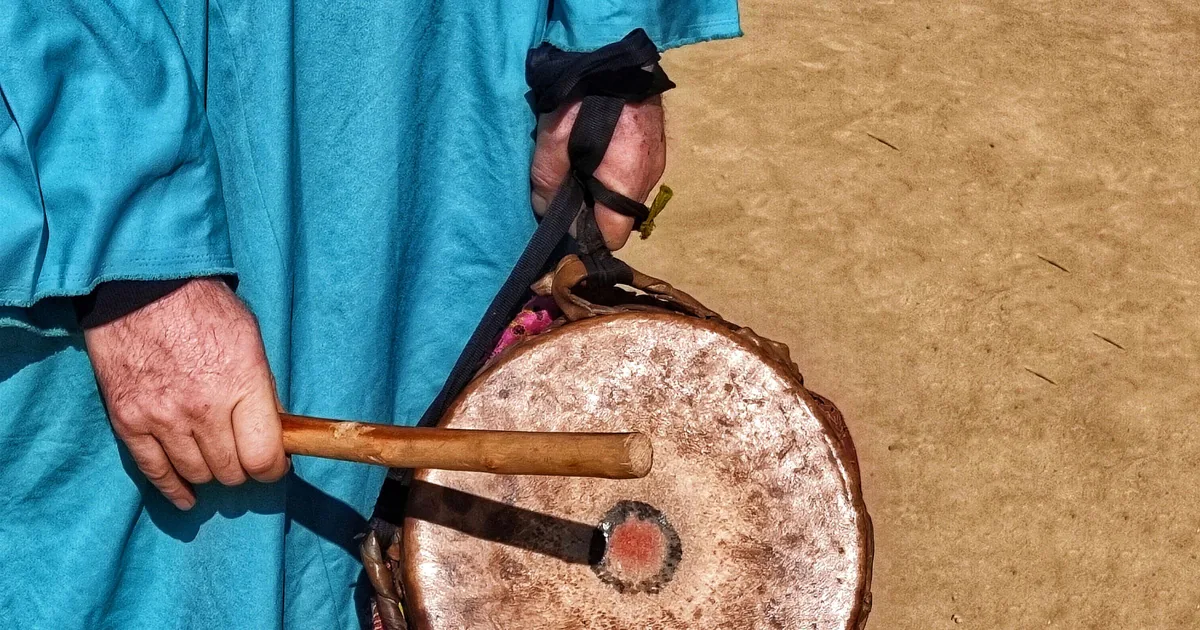
The two heads are also why it lasted. Rope lacing threaded through leather hoops and tightened by sliding rings tunes both skins without a single metal lug, and a paste of flour and iron filings on the larger head drops its pitch to the deep Ge you hear on it today.
The four bols: Ge, Ka, Na and Ti
Every dholak part you have ever tapped your foot to is built from a handful of strokes. The larger head on the left gives the low Ge and the muted Ka slap; the smaller head on the right gives the ringing Na and the sharp Ti click against the rim.
Learn them as sounds rather than as hands: the open strokes ring, the muted strokes stop. A groove is only a pattern of ringing and stopped sound, and dholak parts become readable the moment you can hear that difference.
Play the four strokes on the virtual dholak
| Bol | Hand | Comes from | What you hear |
|---|---|---|---|
| Ge | Left | Large bass head, centre | Open low boom |
| Ka | Left | Large bass head, held flat | Muted slap with no ring |
| Na | Right | Small treble head, near the edge | Bright open ring |
| Ti | Right | Rim and shell | Sharp wooden click |
The four core dholak bols and where each one comes from.
Technique: what to practise first
Hold the drum the way it expects to be held: tilted, larger head to your left, resting low so the right hand stays free. Tension is the enemy — loose wrists, fingers that rebound off the skin instead of pressing into it.
Ge comes from a relaxed finger drop near the centre of the bass head, left to ring. Ka is the same hand laid flat so it stops the skin. Na lands near the edge of the treble head where it rings brightest, and Ti is a knuckle or ring finger tapping the rim. Keep the hands independent: the bass hand keeps the count, the treble hand decorates it.
- Practise at half tempo with a metronome until the strokes alternate without thinking — accuracy long before speed.
- Loop open against muted on one hand, Ge Ka Ge Ka, and feel the rebound; the release is the technique.
- Keep elbows low and wrists loose — stiff arms choke the head and turn Ge into a dead thud.
- Record two minutes a day on the page’s own recorder and listen back a day later; timing is easier to hear than to feel.
Rhythms to learn first, and how to fit them together
Start with Keherwa, the eight-beat cycle behind most film songs and a great deal of folk music: Dha Ge Na Ti Na Ka Dhi Na. Count it as four pairs, play it slowly, and only speed up once both hands agree on every beat.
Dadra, six beats, comes next — it underpins ghazal- and thumri-derived film songs. From there the same four strokes carry a borrowed sixteen-beat tintal, which is exactly how dholak players line up with tabla parts in a full band.
Open the dholak and loop these patterns
| Cycle | Beats | Bol phrase | Where you hear it |
|---|---|---|---|
| Keherwa | 8 | Dha Ge Na Ti Na Ka Dhi Na | Film songs, folk and bhangra |
| Dadra | 6 | Dha Dhi Na Na Ti Na | Ghazal and thumri-style songs |
| Tintal, borrowed | 16 | Dha Dhi Dha Ta Dhi Dha Dha Ti Na | Tabla-led and full-band parts |
Three cycles worth learning in this order.
Practise on the dholak you already have
You do not need an instrument to start. The virtual dholak mirrors the real layout — bass on the left, treble on the right — with the same four strokes on touch pads, on the F/D and J/K keys, or on a connected MIDI controller.
Mark the strokes of a groove, then play them back as a Sequence to loop it; play along with a metronome and record the take when it holds. Fifteen steady minutes a day will take you further than an hour of noodling on the weekend.
Add melody: pair the groove with a sitar
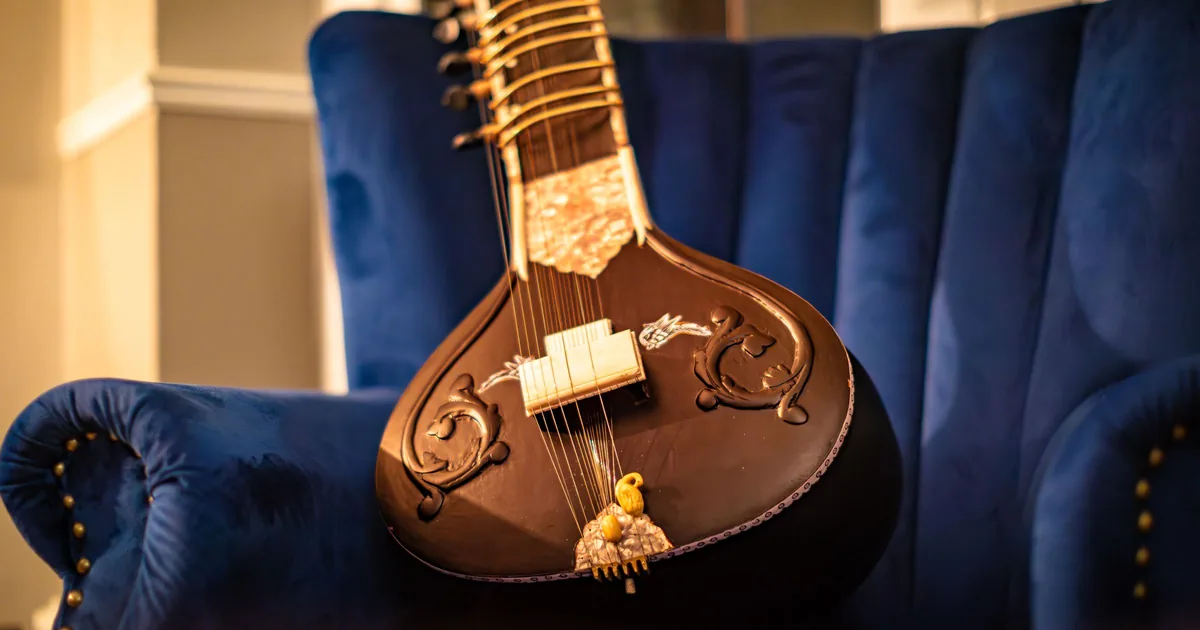
A dholak holds time; a sitar carries the tune. Both live on this site, and both are worth an afternoon: the sitar is the long-necked plucked lute of North Indian classical music, with sympathetic strings that keep ringing underneath every phrase.
The pairing is older than the recording studio — a rhythm cycle underneath, a melodic line on top is how a North Indian piece is built. Keep a Keherwa going with your left hand and pick the sitar with your right, and you are already playing the shape of a raga accompaniment.
常见问题
- How old is the dholak, and who invented it?
- No single inventor or invention date is on record: the dholak is a folk drum that appears in South Asian practice centuries before anyone documented it. Musicologists trace it to the pataha, a medieval drum of North India, and by the Mughal period (1526–1857) it was already established in court, professional and household music alike.
- What are the four dholak strokes called?
- The four core bols are Ge, the open bass note on the large head; Ka, a muted slap on the same head; Na, the open ringing note on the small treble head; and Ti, the sharp click on the rim. Almost every folk dholak part is built from those four.
- Is the dholak easier to learn than the tabla?
- For a beginner, usually yes. The dholak needs no bol vocabulary of its own to play a groove, has no separate dayan tuning ritual, and four strokes cover most folk and film parts. The tabla goes much deeper once you want classical repertoire and its tuning discipline.
- How can I practise dholak if I do not own one?
- Use the free virtual dholak: the four pads sit in the same layout as the real drum, the F/D keys take the left hand and J/K the right, and MIDI controllers map low notes to bass and high notes to rim. Mark a groove, loop it as a Sequence, and add a metronome.