Practice on an online virtual drum simulator
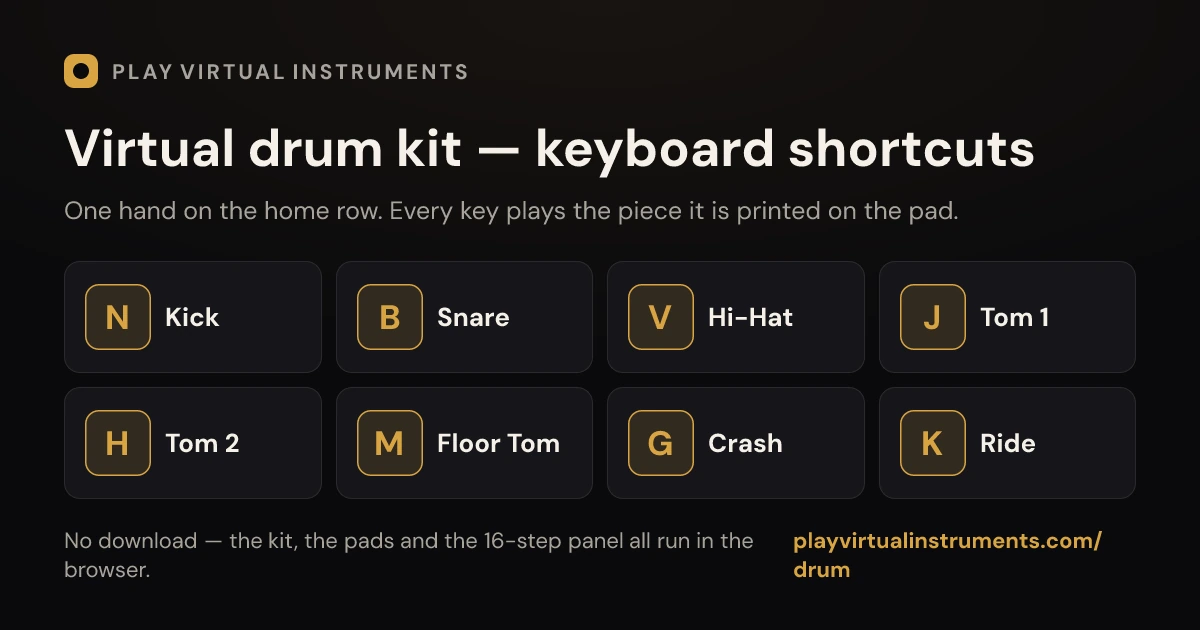
The fastest way to learn to play drum online is a keyboard and a browser. A virtual drum pad turns the keys in front of you into a kit — one for the hi-hat, one for the snare, one for the kick — and eight pieces are playable at the same time. Nothing is installed, nothing needs tuning, and the sound arrives the instant you press a key. That last detail matters more than it sounds: a delay of even twenty milliseconds between your finger and the attack is enough to make a beginner slow down and start guessing.
What you are really training is independence. Play the kick with your thumb and the snare with your other hand and you are rehearsing the same two-limb problem that a pedal and a drumstick create, minus the stool. Because the keys make no acoustic noise, you can do it at one in the morning with headphones on.
Use the tempo counter to keep yourself honest. Set 80 BPM, play the kick on the beat and the snare on two and four for two minutes, then stop the moment the pattern drifts. That single exercise is the core of most virtual drum lessons, and it costs nothing to repeat tonight.
Two things are worth checking before you commit to a browser kit. First, latency: hit a pad and listen for a gap between the click of your finger and the attack of the drum. Second, mapping: can you reach the kick, snare and hi-hat without moving your hand off the keyboard? If either feels wrong you will spend your practice fighting the tool rather than learning a groove, and no amount of enthusiasm fixes that.
Pad and pillow drills for rudiment practice
Every drummer owns a practice pad, and every beginner can improvise one. A cushion, a folded towel or the edge of a mattress gives enough rebound to work on grip without a kit in the room. Sit upright, let the stick rest in the first knuckle of the index finger with the thumb on top, and keep the wrist loose. Matched grip — the same in both hands — is the default for beginners because either hand can lead.
Start with the single stroke roll: right, left, right, left, even, at whatever tempo you can keep identical. Then the double stroke roll, two bounces per hand, which teaches the fingers and the wrist to work together. Count out loud. A metronome at 60 BPM is more useful here than speed, because the goal is a stroke that sounds the same every single time.
Two minutes of single strokes and two of double strokes, every day, changes your hands faster than an hour once a week. Rebound is the whole point: you are learning to let the stick come back up instead of forcing it back down.
If you have no sticks yet, your palms work too — tap alternate hands on your knees to the same counts. It is a humbler sound, but the coordination transfer is real, and it means the very first exercise costs nothing at all.
Limb independence: how to play snare drum and bass drum
Once your hands are steady, add the foot. This is how to play bass drum in virtually every popular style, and the pattern is simple on purpose — one hit on beat one, another on beat three — because the difficulty is never the notes, it is playing them while everything else happens. Tap your foot quietly and keep the movement in the ankle rather than the whole leg.
Play the snare drum on beats two and four, then count 1-2-3-4 aloud while both hands and the foot work. If the counting stumbles, the pattern is above your current coordination, so drop the tempo rather than trying harder. Add the hi-hat on every eighth note and you have the basic rock beat: kick on one and three, snare on two and four, hi-hat through all eight.
This is why a virtual drum set is a genuinely useful way to learn to play drum set coordination rather than a toy. Each row lights up as the limb would strike, so the relationship between the hands and the foot becomes something you can see instead of something you guess at.
Expect the third limb to be the one that breaks the pattern. Two limbs are easy — your hands can argue with each other all day and still land together — but the moment a foot joins in, one limb starts following the others instead of holding its own place. When that happens, isolate it: play the foot alone for a bar, then the hands alone, then put them back together at half the speed. Ten minutes of that beats an hour of playing the whole beat badly.
Build a beat in a free play drum beats panel
A step sequencer shows rhythm as a grid, and a grid is the clearest way to understand subdivisions you have only ever felt. Seven rows of drums, sixteen columns, one column per sixteenth note: seen this way, "the groove" stops being mysterious and becomes a pattern you can point at.
Start with the anchors only — kick on step one, snare on five and thirteen — then fill hi-hats into every second step. Play it back and change one thing at a time. Turn the swing dial to hear the same pattern shuffled, push the tempo from 80 to 140 and notice which parts fall apart first.
Programming a beat and then playing it by hand is the fastest feedback loop a beginner has: the ear learns the shape while the hands learn the timing, and each one makes the other easier.
Save the pattern when it works, and build a small library of two-bar grooves over a fortnight: one straight, one with swing, one that leaves the first beat empty. Drumming is mostly vocabulary, and this is how you collect it without a kit in the room.
3 easy to play drum songs for beginners
Songs are how patterns stop being exercises. All three of these are built on a kick-and-snare skeleton you can already play with two limbs, and all three are slow enough to finish. Play along with the record rather than a click wherever you can: the band is the metronome, and following it teaches you to listen while you play, which no exercise does.
- Seven Nation Army — one bass-drum note per phrase and a plain backbeat, which is why it is the first song most drum teachers hand out.
- We Will Rock You — stomp, stomp, clap. Three strokes, and it is the most recognised drum pattern in the world.
- Another One Bites the Dust — the same backbone with a busier kick, the natural next step once the backbeat is automatic.
What to do tonight
Pick one of the five. Open the drum page, set the tempo to 80 BPM and play a backbeat until it feels boring — boring means memorised. Tomorrow, spend ten minutes on a cushion before you open the laptop. In a few weeks, walk into a music shop and sit at the kit: you will already know what your hands and feet are supposed to do, and the only genuinely new thing left will be the rebound.
常见问题
- Can you learn drums without a drum set?
- Yes. Timing, stroke technique and limb independence are the hard parts of drumming, and all three can be trained with a browser drum pad, a cushion and a metronome. A real kit adds rebound, volume and pedal feel — worth having, but not something you need on day one.
- Is a virtual drum pad as good as a real kit for practice?
- Not the same, and not worse for the skills you learn first. A pad teaches you where the notes sit and how the limbs fit together; a real kit teaches dynamics and rebound. Many teachers start students on a pad for exactly that reason.
- How do I play the snare drum and bass drum in 4/4?
- Play the kick on beats one and three and the snare on two and four, counting out loud. Add the hi-hat on every eighth note for the basic rock beat, and slow the tempo down until the foot and the hands stay locked together.
- How long does it take to play a basic drum beat?
- Most people can hold a simple kick-and-snare beat within a few sessions if they slow it down and count aloud, and a steady groove at 100 BPM within about a month of short daily practice.