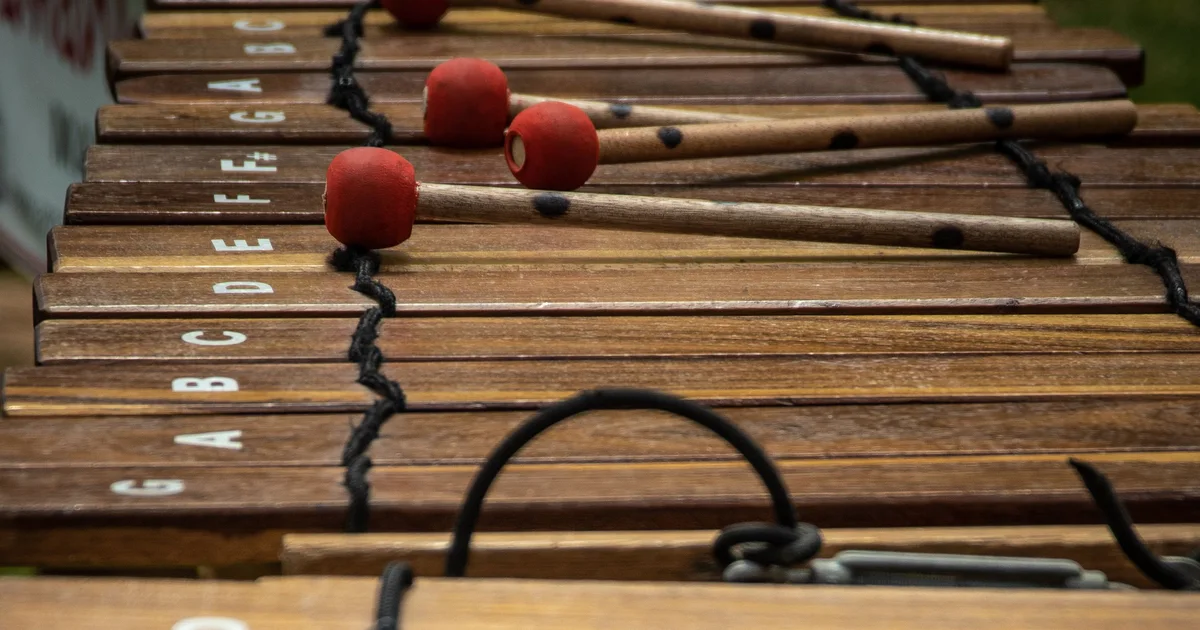
Play Xylophone Online — Free Virtual Xylophone with Tuned Wooden Bars
Strike a virtual xylophone in your browser: two chromatic octaves of tuned wooden bars with a hard mallet, keyboard and MIDI, record and download.
Strike the wooden bars or the note strip: Z–M play C4–B4 and Q–U play C5–B5. Every bar is one hit, so fast runs are easiest with alternating hands.
How to Play in Four Steps
- Tap a bar — the longest bar on the left is the lowest note, and the run climbs to the right.
- Use two hands alternately for fast passages, like a mallet player bouncing the stroke.
- Mark a phrase you want to practise, then loop it with Sequence or strike it with Together.
- Play along with a MIDI keyboard, then record the run and download the file.
A Short History of the Xylophone
Struck wooden bars are among the oldest tuned instruments: balafons and marimbas in West and Central Africa, and ranat instruments in Thailand and Cambodia, all tune wood by shaping it and all add resonators underneath.
The orchestral xylophone is a nineteenth-century European descendant of those models. Saint-Saens put it in Danse Macabre in 1874 to sound like rattling bones, and by the twentieth century Gershwin, Shostakovich and every film-score composer had found a use for it.
Acoustically, a struck bar vibrates in a strongly inharmonic series — the overtones are not simple multiples of the fundamental, which is why a xylophone sounds bright and hollow rather than warm — reproduced here with the first four bar partials.
Xylophone Quiz
0 / 3 · Score
What is a xylophone made of?
How is each bar tuned?
Which piece made the xylophone famous for bones?
Frequently Asked Questions
Strike a bar with the pointer, tap a note in the strip, press the two keyboard rows, or connect a MIDI keyboard. Every path plays the same hardened-mallet bar.
Both are tuned wooden bars, but a xylophone uses hard mallets on short, thicker bars for a bright, dry attack, while a marimba has resonant tubes and soft mallets for a rounder, lower sound.
A bar is tuned by its length: the longer and heavier it is, the lower it sounds. Real xylophones graduate bar size from bass to treble, and this board draws the same shape.
Two chromatic octaves from C4 to B5, accidentals included, which covers most orchestral xylophone writing and every school method book phrase.
Yes. Use two hands alternately and keep the mallet bounce small; the voice is a short, percussive decay so repeated notes stay separate rather than blurring together.
Wooden-bar instruments are ancient in Africa and Southeast Asia, and the tuned orchestral xylophone was developed in Europe in the nineteenth century from those models.
Saint-Saens uses it for the skeletons in Danse Macabre, Gershwin gives it a solo in An American in Paris, and it is a fixture of musical-theatre and film scores.
Yes. Record, play, stop, then download. The take is written by the browser from the master bus — no upload, no account.