Play Berimbau Online — Free Virtual Musical Bow from Brazil
Play a virtual berimbau in your browser: one wire, a gourd and a coin, with the open, pressed and harmonic voices of a capoeira roda — no download.
Six pitches on one wire: Z–N from the low open note to the high harmonic. Alternate the low notes to feel the capoeira toque.
How to Play in Four Steps
- Tap a point on the wire — the notes are the open, pressed and harmonic voices of one string.
- Keep a low note repeating and answer it with a high one: that call and response is a toque.
- Mark that pattern, then play it back as a sequence while you add the answers by hand.
- Record the toque and download it to practise the capoeira rhythm away from the page.
A Short History of the Berimbau
Musical bows are among the oldest string instruments in the world, and the berimbau came to Brazil with enslaved Africans, who kept its wire, gourd and coin intact through the Atlantic crossing.
In Brazil it became the lead instrument of the capoeira roda: the berimbau sets the toque, the toque sets the tempo, and the tempo sets what kind of game the two players have. It has since moved into Brazilian popular music, jazz and film scoring.
Acoustically, a steel wire over a gourd gives a bright, buzzing tone, and pressing a coin against it shortens the vibrating length to raise the pitch — reproduced here with a band-passed wire, a pitch pull and a rattle.
Berimbau Quiz
0 / 3 · Score
What is a berimbau?
Which tradition leads with the berimbau?
What is pressed against the wire to change pitch?
Frequently Asked Questions
Tap a pitch on the wire, tap a note in the strip, press Z to N, or connect a MIDI keyboard. Each plays a wire tone shaped by the gourd and the coin.
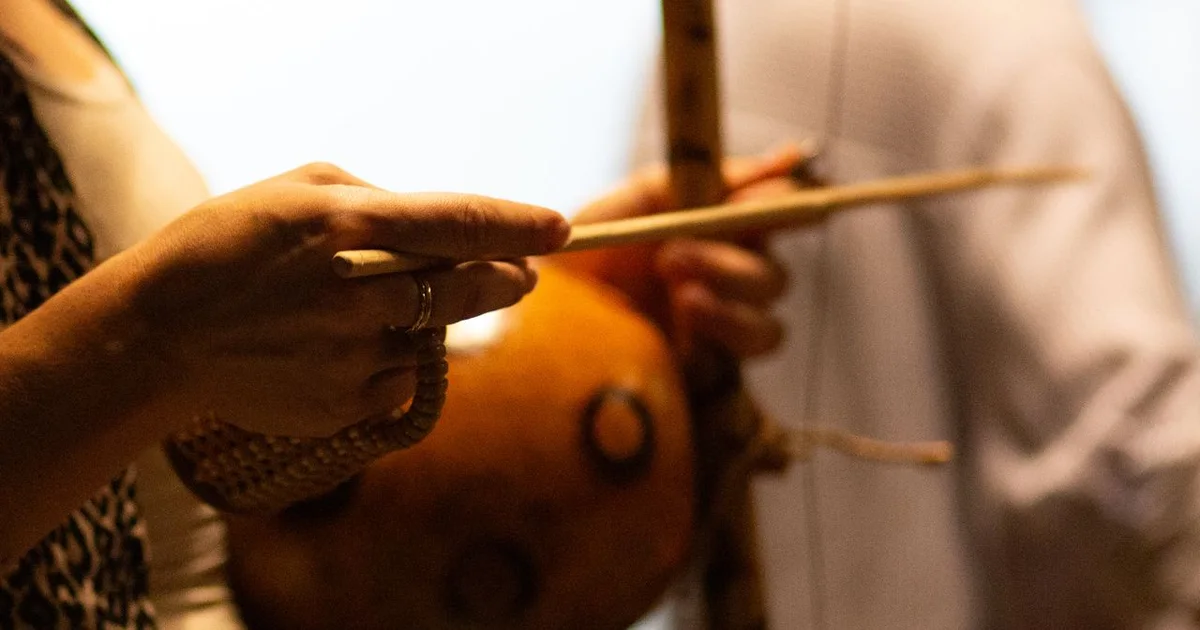
A Brazilian musical bow: a wooden stave, a steel wire and a dried gourd resonator, with a coin or stone pressed against the wire to change its pitch.
Because one wire gives you three usable voices — open, pressed and harmonic — not a scale. A berimbau player builds rhythm from those voices, not from a melody of many pitches.
The rhythmic pattern a berimbau plays. The toque sets the tempo and character of a capoeira roda, and each one signals a different kind of game.
A caxixi, a small woven rattle. The berimbau player holds it with the stick hand, so the wire and the shaker are struck in one motion.
It is African in origin and travelled to Brazil with enslaved people; it became central to capoeira and to Brazilian folk music, and it is now heard in jazz and film scores too.
The wire buzzes against the coin and the gourd amplifies it, so the sound is brighter and dirtier than a clean string pluck — this simulator models that with a band-passed wire and a fast tremolo.
Yes. Record, play the pattern, stop and download. The file is written by the browser from the master bus, with no account.