Play Violin Online — Free Virtual Violin with Vibrato
Bow two octaves in your browser with a warm vibrato violin tone, keyboard and MIDI — no download.
Bottom row plays G3–F#4, top row G4–F#5, I plays the top G5. Keys Z–M, Q–U and I.
How to Play in Four Steps
- Play the two-octave fingerboard — bottom row G3–F#4, top row G4–F#5 — with glissando slides.
- Hold notes and hear the vibrato bloom in after the bow attack, like a real player.
- Shift octaves or connect a MIDI keyboard for violin lines across the range.
- Record your take straight from the master bus.
A Short History of the Violin
The violin took shape in 16th-century Cremona, Italy, where the Amati family refined earlier bowed fiddles into the four-string form we know. Antonio Stradivari and Giuseppe Guarneri then perfected it in the 1700s, and their instruments remain the most prized ever made.
Legendary players run from Niccolò Paganini to Itzhak Perlman. The violin leads orchestras everywhere, but it is also the voice of folk traditions from Irish fiddling to Indian classical music. Join that lineage on the free virtual violin instrument above — an interactive violin online, right in your browser.
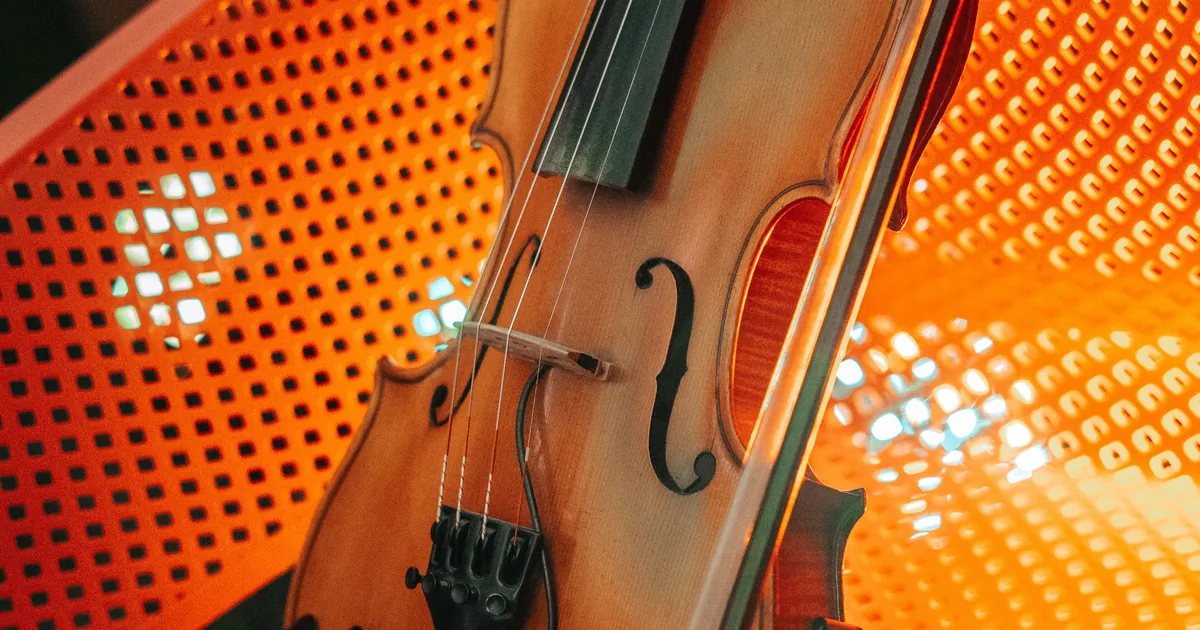
Acoustically, bow friction vibrates four strings over a carved spruce body and f-holes — reproduced here with a bowed sawtooth voice and blooming vibrato.
Violin Quiz
0 / 3 · Score
How many strings does a violin have?
Which Italian city is the historic home of violin making?
What are the violin strings tuned to, from lowest to highest?
Frequently Asked Questions
Play the on-screen keys, use Z–M for the lower octave, Q–U plus I for the upper, or connect a MIDI keyboard. Every note bows with a vibrato that blooms in.
Two octaves from the open G string: G3 to G5, with an octave shift that reaches one octave down and up.
Two bowed octaves are mapped to your QWERTY keys: Z–M plays G3–F#4, Q–U plus I plays G4–G5. Press the keys to bow pitches instantly with smooth attack and blooming vibrato.
Yes! Connect any USB MIDI keyboard to play notes with dynamic velocity, folded into the two-octave range via Web MIDI.
It is built for it: the free virtual violin instrument shows numbered note chips, note names and QWERTY hints — an interactive way to learn violin notes online.
None. The violin runs 100% inside your browser using the Web Audio API with zero latency and no account creation.